By Moses Moses
The League of Legal Practitioners of Nigeria (LOLPON) has defended former Minister of Petroleum Resource, Mrs. Diezani Alison-Maduke who is facing prosecution at UK court, saying nothing has been proven against her as the burden of proof has not been discharged. She was a minister during the reign of ex-President Goodluck Jonathan.
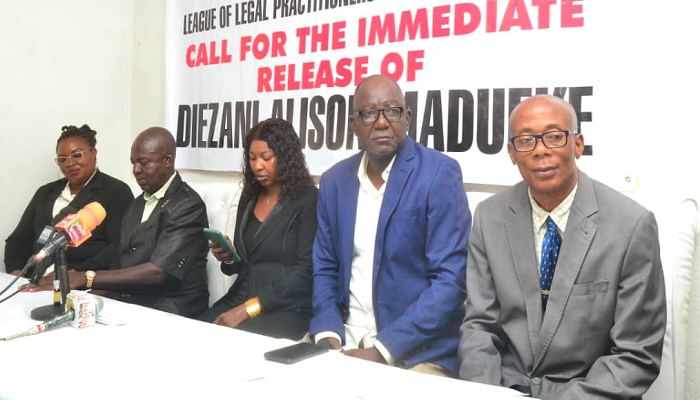
According the speech titled ‘A legal examination of the trial of Diezani Alison-Madueke and the imperative of justice under Nigerian and United Kingdom law’, delivered by LLPON at a press conference in Abuja on Thursday, the essential elements of the alleged offences remain unestablished, because the material contradictions have created overwhelming reasonable doubt, adding that justice must be evidence-based, impartial and must not be presumed.
“We call on the United Kingdom judicial authorities to ensure that this matter is determined strictly in accordance with the law, free from bias, conjecture, or external pressure”.
Speaking further, the group said: The League of Legal Practitioners of Nigeria (LOLPON) has undertaken a comprehensive legal review of the ongoing trial of Nigeria’s former Minister of Petroleum Resources, Diezani Alison-Madueke, currently before a United Kingdom court.

“Our position is strictly legal, objective, and grounded in established principles of law.
“After a careful and dispassionate review of the facts available in the public domain, we state clearly and unequivocally that nothing has been proven against the Defendant. Allegations remain allegations. In law, they do not translate to guilt until proven beyond reasonable doubt. That threshold, as it stands today, has not been met”.
The group said under the Human Rights Act 1998 and Article 6(2) of the European Convention on Human Rights, every accused person is presumed innocent until proven guilty, and that this is not symbolic, binding. It said the Defendant has consistently denied all allegations, and the burden lies entirely on the prosecution, and at this stage, that burden has not been discharged.
“Failure to establish the elements of bribery under the UK Bribery Act 2010, a conviction requires clear proof of a financial or material advantage, a direct link to improper conduct, a clear intention to influence official decisions.
“However, critical gaps remain alleged bribe payers have denied making any payments, there is no conclusive linkage between alleged benefits and contract awards, no direct evidence of corrupt intent has been established, and this leaves the prosecution’s case legally fragile”, the group alleged.
Speaking further, the group said that both Nigerian and UK law require proof of the act and the intention.
“There is no conclusive evidence that the Defendant demanded, received, or intended to receive bribes in exchange for official actions. Without these, criminal liability cannot arise”.
It said, under Nigerian procurement practices and administrative culture, contract awards are institutional, not personal as so ministers do not act in isolation; stakeholder interactions between contractors and government officials are not unusual within regulated boundaries.
“It is also important to state that in certain operational contexts, contractors often provide logistical support within the framework of ongoing engagements. Such interactions, in themselves, do not automatically constitute criminal conduct under Nigerian law unless tied directly to proven corrupt intent”, the group added.