In the proposed 2027 budget, ₦960 billion, representing 80 per cent of the total outlay, has been earmarked for capital projects. The remaining ₦240 billion is allocated to recurrent expenditure
By Emeka Nwosu, PhD
On Thursday, November 18, 2026, Abia State Governor, Dr Alex Chioma Otti, presented the proposed 2027 budget to the State House of Assembly. The presentation marked the fourth budget proposal of his administration and the last in his first tenure, which is expected to end in May 2027.
Titled “Delivering Today, Energising Tomorrow,” the proposed budget is significant for several reasons. With a total expenditure projection of ₦1.2 trillion, it is the largest budget presented by the Otti administration since assuming office, reflecting a steady expansion in the state’s fiscal outlook and development ambitions.
The proposed budget represents an 18 per cent increase over the 2026 budget of ₦1.016 trillion. For perspective, Otti’s maiden budget, presented on December 12, 2023, stood at ₦567 billion, representing a dramatic increase of 253.4 per cent over the ₦160.5 billion budget of the preceding administration of former Governor Okezie Ikpeazu.
Since then, the governor has sustained the upward trajectory in budgetary allocations. In 2025, the state’s budget stood at ₦750 billion, while the 2026 budget rose to ₦1.016 trillion.
More remarkable, however, is the consistent emphasis on capital expenditure in the successive budgets. This underscores Otti’s determination to prioritise infrastructure development and lay the foundation for a more productive and prosperous Abia State.
From his maiden budget to the proposed 2027 estimates, at least 80 per cent of the total budgetary provisions have consistently been directed towards capital expenditure, while the balance has been allocated to recurrent expenditure, covering personnel costs, salaries, pensions, gratuities and other government obligations.
In the proposed 2027 budget, ₦960 billion, representing 80 per cent of the total outlay, has been earmarked for capital projects. The remaining ₦240 billion is allocated to recurrent expenditure.
This budgetary structure sends a clear message about the administration’s development philosophy: prioritising investment, production and infrastructure over excessive consumption. It also demonstrates that Governor Otti has no intention of slowing down his drive to transform Abia into a modern economy supported by world-class infrastructure.
Education and Healthcare Take Centre Stage
Consistent with his conviction that education and human capital development are essential to sustainable growth, Governor Otti has continued to prioritise the education and healthcare sectors.
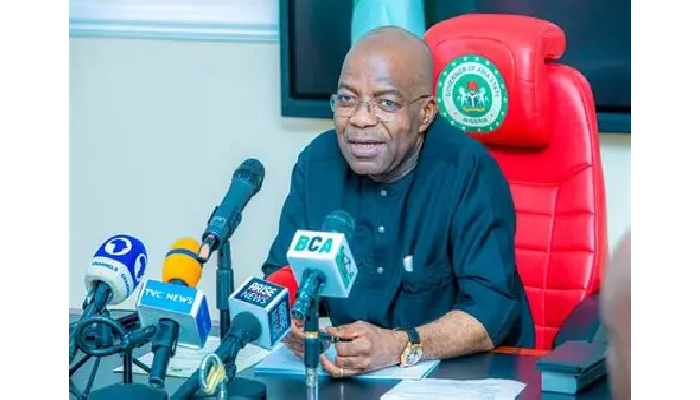
The proposed 2027 budget allocates 35 per cent of its total expenditure to these two critical sectors. Education is expected to receive 20 per cent, while healthcare is allocated 15 per cent.
The healthcare allocation is particularly noteworthy, as it meets the 15 per cent benchmark recommended under the Abuja Declaration of 2001, which called on African governments to commit at least 15 per cent of their annual budgets to improving healthcare delivery.
This commitment reflects an understanding that physical infrastructure alone cannot guarantee sustainable development without corresponding investments in the health, education and overall well-being of the people.
Improved Internally Generated Revenue
Another encouraging feature of the proposed budget is the growing contribution of Abia’s Internally Generated Revenue (IGR) to government financing.
The state projects an IGR of ₦199.8 billion for the 2027 fiscal year. According to the budget projections, this revenue is expected to finance a substantial proportion of recurrent expenditure.
This is significant because it suggests that the state is increasingly strengthening its capacity to meet its routine financial obligations through internally generated resources rather than depending excessively on monthly federal allocations.
It also indicates that the administration is making progress in expanding the state’s revenue base and improving its capacity to generate wealth independently.
Beyond IGR, the governor identified statutory allocations from the Federation Account Allocation Committee (FAAC), Value Added Tax (VAT) receipts and recurrent grants as other major sources of funding.
A combined ₦647.33 billion is expected from these sources, while the remaining ₦553.67 billion is projected to come from concessionary loans. The administration has indicated that the loans will be channelled strictly into infrastructure projects with the potential to generate long-term economic returns.
The emphasis on directing borrowed funds towards productive capital investments is important. Properly executed, such investments can stimulate economic activities, create employment opportunities and expand the state’s future revenue base.
Expectations for Major Infrastructure Projects
With the proposed 2027 budget structured around an ambitious capital expenditure programme, Abians have every reason to expect the completion of ongoing projects and the commencement of new development initiatives across the state.
Although the Ministry of Finance is yet to release the full details of the budget, expectations are already high regarding the government’s plans for critical projects, including the Abia Stadium Village in Umuahia, the proposed airport project at Nsulu and the reconstruction of the old Okpara Road in Ohuhu, Umuahia.
These projects, among others, are expected to feature prominently in the administration’s development agenda as it seeks to consolidate its achievements and expand the state’s infrastructure network.
The importance of these investments cannot be overstated. Beyond their immediate benefits, projects of this nature have the potential to stimulate commerce, attract private investment, improve connectivity and create employment opportunities for residents.
Consolidating the Gains of Three Years
Three years into the Otti administration, Abia has witnessed developments across several sectors, particularly infrastructure, education, healthcare and public-sector administration.
The progress recorded so far has raised expectations among residents, who are looking to the 2027 budget to consolidate existing achievements while extending the reach of development to more communities across the state.
Governor Otti has, through his performance, earned considerable public confidence. The challenge before his administration is to translate the ambitious projections in the proposed budget into tangible outcomes that directly improve the lives of ordinary Abians.
The governor himself appears confident about the task ahead. Speaking during the budget presentation, he described the proposal as both realistic and ambitious, acknowledging the challenges that remain while expressing confidence in his administration’s capacity to overcome them.
He said: “Generally, the proposed budget is as realistic as it is aspirational, reflecting the magnitude of our ambition, just as it acknowledges the long path we still have to travel to arrive at our preferred destination. The interesting thing is that our ship has since left the harbour and we have demonstrated sufficient capacity and resilience to weather whatever storms that lie ahead.”
These words capture the administration’s determination to sustain its development drive despite the challenges that may lie ahead.
The Legislature’s Responsibility
With the presentation of the 2027 Appropriation Bill, attention now shifts to the Abia State House of Assembly, which has the constitutional responsibility to scrutinise the proposals, conduct the necessary legislative processes and pass the budget into law.
Given the importance of the proposed expenditure programme, the Assembly is expected to give the bill thorough but timely consideration to enable the government to commence implementation without unnecessary delays.
Ultimately, the success of the 2027 budget will not be measured by its impressive figures or ambitious projections alone, but by the extent to which the promised projects are delivered and the lives of the people are positively transformed.
As Governor Otti continues his drive to deliver the dividends of good governance, the expectation is that the proposed budget will not only sustain the momentum of development but also energise the future of Abia State.
The task ahead is clear: consolidate the gains, deepen development and ensure that no part of the state is left behind.
May Abia continue to prevail!
Dr Emeka Nwosu, a Public Policy Analyst, writes from Umuahia.
Email: cdnwosu2@gmail.