By Uche Nnadozie
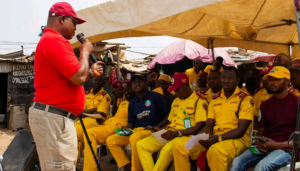
History is not always made in grand chambers or gilded halls. Sometimes, it is made in the dust and diesel rhythm of a motor park. At the Jabi Motor Park in Abuja, a new kind of politics — people-centred, practical, and unapologetically grassroots — took shape as the Transporters for Tinubu 2027 support group flagged off the Drivers’ Care Initiative. It was not a ribbon-cutting ceremony for optics. It was an intervention — direct, urgent, and long overdue.
For too long, Nigeria’s transport workers have operated at the margins of policy conversations, even though they sit at the centre of our economic survival. From the long-haul trailer driver moving goods across fragile highways to the urban bus operator navigating chaotic city traffic, these men and women are the invisible engine of commerce. When they stop, Nigeria stops.
The Drivers’ Care Initiative recognizes that truth.
This programme is simple in concept but revolutionary in implication: free eye testing and care for drivers; drug abuse sensitisation; and access to soft loans through a Transporters Cooperative Society. In other words, protect their health, sharpen their awareness, and strengthen their economic footing.
That is not charity. That is strategy.
Prince Segun Obayendo, National Coordinator of the group, captured it succinctly: drivers are the soldiers of transportation. Without them, the economy collapses. His words are not hyperbole. They are a reminder that logistics is the bloodstream of national productivity. Markets depend on it. Families depend on it. Government revenues depend on it.
So why have we historically neglected the welfare of the very people who make mobility possible?
Consider the eye-care component alone. Vision is everything for a driver. Poor eyesight is not just a personal health issue; it is a public safety risk. Yet many commercial drivers cannot afford routine eye tests, let alone corrective care. By providing free screenings and treatment, this initiative tackles road safety at its root — before tragedy strikes.
Then there is the hard truth delivered by an official of the National Drug Law Enforcement Agency (NDLEA) at the event: a significant proportion of road accidents in Nigeria are drug-related. That statistic should alarm every commuter and policymaker. Substance abuse — from high-dose tramadol to excessive alcohol and even stimulants often dismissed as harmless — impairs judgment, slows reaction time, and turns vehicles into weapons.
The warning was blunt and necessary: say no to drugs, say yes to life. For drivers, that message is existential. For passengers, it is reassuring.
The economic plank of the initiative may prove just as transformative. Access to soft loans through a cooperative structure is a lifeline for drivers trapped in predatory financing arrangements or daily “hire purchase” cycles that leave them perpetually indebted. Cooperative-based funding builds ownership, stability, and dignity. It shifts drivers from survival mode to growth mode.
And the ambition does not stop in Abuja. The initiative is set to expand across all 36 states and the Federal Capital Territory by June. Waterway operators in Warri have already been engaged — a critical move in a country where marine transport remains underutilised yet vital.
This is how movements gain legitimacy: by moving beyond slogans into systems.
Support from transport unions reinforces the seriousness of the effort. The Chairman of the Nigerian Association of Road Transport Owners (NARTO), Alhaji Musa Saidu, pointed to broader interventions under President Bola Ahmed Tinubu — including fare relief measures and the rollout of compressed natural gas (CNG) buses — as evidence of a government responsive to transport realities.
Meanwhile, the Vice Chairman of the Road Transport Employers’ Association of Nigeria (RTEAN), Alhaji Umar Abubakar, offered a metaphor that cuts to the heart of the matter: the eyes are the life of a man. Without them, he said, we are useless. In the transport sector, that statement is literal.
But beyond health checks and policy endorsements lies a deeper narrative.
The Drivers’ Care Initiative signals a political philosophy that understands something fundamental: reforms succeed when they reach the base. Motor parks are not just transit hubs. They are micro-economies. They are social networks. They are political constituencies. To invest there is to invest where policy meets daily life.
Critics may dismiss support groups and initiatives tied to political movements as mere mobilisation tools. Yet when mobilisation brings measurable social value — safer roads, healthier drivers, financial inclusion — it transcends partisanship. It becomes nation-building.
The real test will be consistency. Will the screenings continue beyond the cameras? Will the loan schemes remain transparent and accessible? Will the anti-drug messaging translate into sustained behavioural change?
If the answers are yes, then what began in Jabi will ripple across Nigeria’s transport corridors.
Our drivers deserve to return home safely. They deserve clear vision, clear minds, and clear economic pathways. They deserve recognition not just in speeches, but in structured support.
Nigeria moves because they move.
Putting them first is not politics. It is common sense and Transporters for Tinubu 2027 group is blazing the trail with the revolutionary Driver’s Care Initiative.