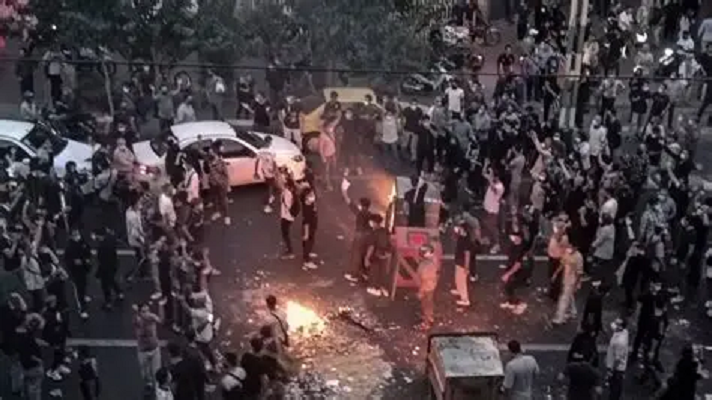
Iran’s Supreme Leader Ayatollah Ali Khamenei has called anti-government protesters “troublemakers” who are trying “to please the president of the US”.
Iran also sent sent a letter to the United Nations Security Council blaming the US for turning the protests into what it called “violent subversive acts and widespread vandalism” in Iran. Trump, meanwhile, said Iran was “in big trouble”.
The protests, in their 13th day, erupted over the economy and have grown into the largest in years – leading to calls for an end to the Islamic Republic and some urging the restoration of the monarchy.
At least 48 protesters and 14 security personnel have been killed, according to human rights groups.
An internet blackout is in place.
“We will be hitting them very hard where it hurts,” Trump said at the White House on Friday, adding that his administration was watching the situation in Iran carefully and that any US involvement does not mean “boots on the ground”.
“It looks to me that the people are taking over certain cities that nobody thought were really possible just a few weeks ago,” he said.
These remarks echo ones the US president made about the Iranian government on Thursday, where he pledged to “hit them very hard” if they “start killing people”.
Khamenei remained defiant in a televised address on Friday.
“Let everyone know that the Islamic Republic came to power through the blood of several hundred thousand honourable people and it will not back down in the face of those who deny this,” the 86-year-old said.
Later, in remarks made to a gathering of supporters and broadcast on state television, Khamenei doubled down, saying Iran “will not shirk from dealing with destructive elements”.
Iran’s United Nations ambassador accused the US of “interfering in Iran’s internal affairs through threats, incitement, and the deliberate encouragement of instability and violence,” in a letter to the Security Council.
Since protests began on 28 December, in addition to the 48 protesters killed, more than 2,277 individuals have also been arrested, the US-based Human Rights Activist News Agency (HRANA) said.
The Norway-based Iran Human Rights (IHRNGO) said at least 51 protesters, including nine children, had been killed.
Iran protesters
BBC Persian has spoken to the families of 22 of them and confirmed their identities. The BBC and most other international news organisations are barred from reporting inside Iran.
In a joint statement, the leaders of the UK, Germany and France said they were “deeply concerned about reports of violence by Iranian security forces, and strongly condemn the killing of protesters”.
“The Iranian authorities have the responsibility to protect their own population and must allow for the freedom of expression and peaceful assembly without fear of reprisal,” French President Emmanuel Macron, UK Prime Minister Sir Keir Starmer and German Chancellor Friedrich Merz said.
UN spokesperson Stéphane Dujarric said the United Nations was very disturbed by the loss of life. “People anywhere in the world have a right to demonstrate peacefully, and governments have a responsibility to protect that right and to ensure that that right is respected,” he said.
Meanwhile the Iranian security and judicial authorities issued a series of coordinated warnings, hardening their rhetoric and echoing an earlier message of “no leniency” by Iran’s top security body, the Supreme National Security Council (SNSC).
Iran’s National Security Council – responsible for domestic security and not to be confused with the SNSC – said “decisive and necessary legal action will be taken” against protesters, which it described as “armed vandals” and “disruptors of peace and security”.
In a brief statement, it warned against “any form of attack on military, law-enforcement, or governmental facilities”. The intelligence arm of Iran’s Islamic Revolution Guard Corps (IRGC) said it would not tolerate what it described as “terrorist acts”, asserting that it would continue its operations “until the complete defeat of the enemy’s plan”.
Reza Pahlavi, the son of Iran’s last shah who was overthrown by the 1979 Islamic revolution, called on Trump on Friday to “be prepared to intervene to help the people of Iran”.
Pahlavi, who lives close to Washington DC, had urged protesters to take to the streets on Thursday and Friday.